


Brokers placing window, door, and glass contractors should clarify three things early: exactly what is being installed, whether any exterior work exceeds two stories, and what equipment or access methods the contractor uses. For USMC, that matters because window, door, and glass submissions can fit when the work stays within stated program parameters, but current appetite, eligibility, and final terms always remain subject to USMC underwriting review.
Why this question matters
Window, door, and glass contractors can look similar on an ACORD form while presenting very different jobsite conditions. A submission focused only on “glass installation” can leave out whether the account installs storefront systems, curtain walls, skylights, automatic doors, or other products that change the exposure picture. That gap slows triage and usually creates follow-up questions that a broker could have answered up front.
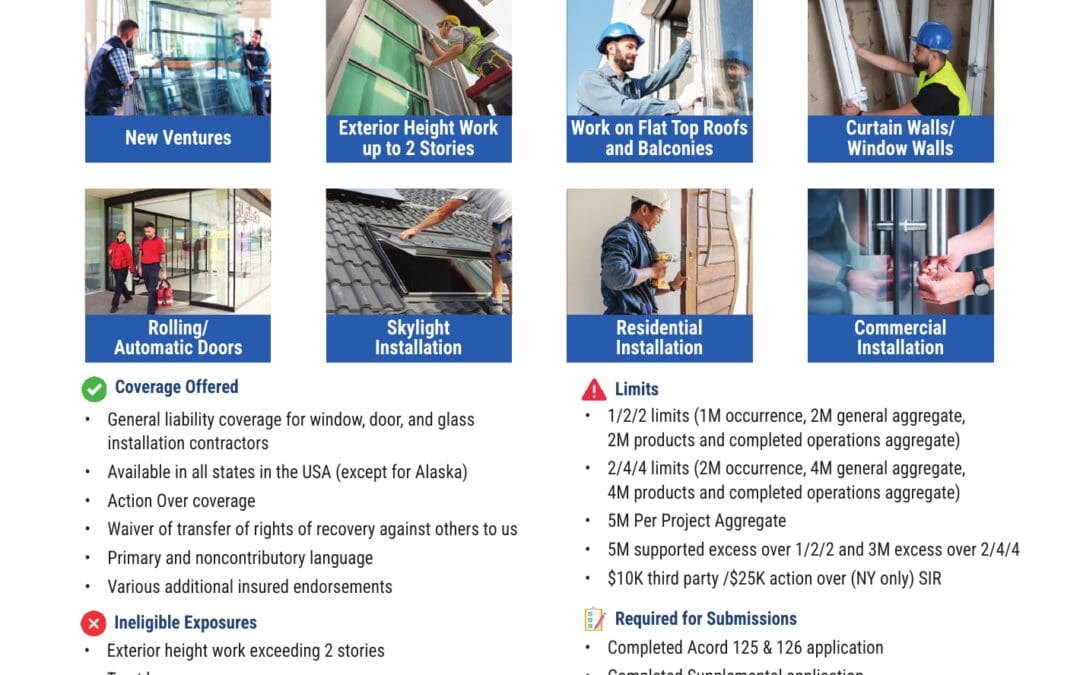
USMC’s current public window, door, and glass program page says the class includes eligible exposures such as new ventures, exterior height work up to two stories, work on flat top roofs and balconies, curtain walls/window walls, rolling/automatic doors, skylight installation, and both residential and commercial installation. The same page also says exterior height work exceeding two stories is ineligible and lists tract homes as ineligible. See USMC’s Window, Door, and Glass Installation Coverage page.
That makes scope clarity commercially important. A broker who distinguishes low-rise storefront work from higher-exposure exterior installation gives underwriting a cleaner starting point and reduces avoidable back-and-forth.
What should brokers clarify first?
1. What products are actually being installed?
Start with a plain-language breakdown of the contractor’s operations. “Window and glass” is too broad by itself. A useful submission should separate storefront glass, curtain wall or window wall work, automatic doors, skylights, interior partitions, mirrors, and standard doors. It should also note whether the insured mainly installs, repairs, fabricates, or mixes those activities.
That distinction matters because not every product creates the same bodily injury or property damage exposure. USMC’s public materials specifically identify curtain walls/window walls, rolling/automatic doors, and skylight installation as relevant exposures in this class. A broker who names the product mix helps underwriting evaluate the account faster and more accurately. For broader program context, brokers can also reference USMC’s Commercial General Liability page.
2. Does any exterior work exceed two stories?
This is the question to answer explicitly, not indirectly. USMC’s public program page says eligible exterior height work is up to two stories and lists exterior height work exceeding two stories as ineligible. If the contractor performs any work above that threshold, a broker should say so clearly rather than burying it in a narrative.
That question also aligns with an authoritative external source. OSHA’s construction fall-protection rule at 29 CFR 1926.501 states that employees working 6 feet or more above lower levels in covered construction situations must be protected by guardrail systems, safety net systems, or personal fall arrest systems. That does not determine insurability, but it is a useful reminder that height changes the operational profile and the questions underwriting will expect a broker to answer.
3. How is the work accessed and installed?
Height alone is not the whole story. Brokers should describe how the work is performed: from the interior, from balconies or flat roofs, or from the exterior with lifts, scaffolding, or other specialized equipment. They should also identify whether large glass units, curtain wall assemblies, or automatic door systems are involved.
Even where a class is generally eligible, the installation method can materially affect the exposure narrative. A submission that says “storefront replacement at low-rise retail locations, installed from grade or interior access” is far more decision-useful than one that simply says “commercial glass work.”
What supporting documents make the submission stronger?
USMC’s current public window, door, and glass page lists the baseline submission package as ACORD 125, ACORD 126, a supplemental application, and five years of loss history, with a resume required if the business has been operating for three years or less. Including those items on the first pass is the simplest way to keep the file moving.
Beyond that baseline, brokers improve the file when they add a short operations summary that answers:
- percentage of work that is residential versus commercial;
- percentage of installation versus repair or fabrication;
- whether any work involves curtain wall, storefront, skylights, or automatic doors;
- whether any exterior work exceeds two stories;
- what access equipment is used on site; and
- whether the insured uses subcontractors for any portion of installation.
None of those details guarantee eligibility or terms, but they do help underwriting understand whether the account fits the program’s stated lane or needs additional review.
How do official classification and safety sources help brokers frame the account?
When brokers need a neutral way to describe the trade, OSHA’s SIC manual entry for Glass and Glazing Work is a useful primary source because it identifies the trade category directly. It is not a coverage document, and it does not answer appetite, but it can help a broker describe the insured’s operations more precisely when the application language is vague.
Likewise, OSHA’s fall-protection rule is not an underwriting rule. Still, it gives brokers a credible reason to ask more detailed questions about exterior height work, access methods, and jobsite controls before sending the file. In practice, the more clearly a broker explains where people are working and how they get there, the easier it is for underwriting to separate routine low-rise installation from more complex exposure.
What does a better broker narrative sound like?
A stronger narrative might read like this: the insured performs primarily low-rise storefront and standard exterior door installation at retail locations; no exterior work exceeds two stories; curtain wall work is incidental or not performed; installation is completed from interior access, grade, or approved lifts; five-year loss history is attached; and the supplemental application explains the split between commercial and residential work.
That kind of narrative is commercially useful because it translates a broad class name into underwriter-ready facts. It also reduces the chance that the submission gets stuck at the “please clarify operations” stage.
What should brokers avoid assuming?
Brokers should not assume that any one detail by itself determines whether an account will be accepted, declined, or modified. A public program page is marketing and triage guidance, not a binding underwriting decision. Final appetite, eligibility, terms, conditions, exclusions, and pricing must come from USMC underwriting based on the full submission.
They also should not assume that “window and glass” automatically means storefront work only. The class can include very different products and installation conditions, and those differences are exactly what should be clarified before the file is sent.
Next step for brokers
If you are preparing a window, door, and glass submission, send the ACORDs, supplemental, and loss history together with a short operations summary covering product mix, installation method, and any exterior height exposure. That gives USMC underwriting a cleaner file to review while keeping final eligibility and appetite decisions where they belong: with underwriting.